


Bank acquisitions and the hidden challenge of corporate migration
Talk of actual and attempted bank takeovers is back in the headlines, with commentators pointing to a new wave of M&A as traditional banks defend their market position against fintech platforms and private credit funds.1 Recent transactions include BMO's acquisition of Bank of the West2; RBC's purchase of HSBC's Canadian business3; Nationwide's integration of Virgin Money4; UniCredit's pursuit of Commerzbank. These mergers have been characterised largely by their size, strategic rationale and implications for competition.
But when a bank agrees a deal to purchase a rival, the transaction itself is only the tip of the iceberg. The work that sits beneath the surface is the operational heavy lifting. Mergers and acquisitions of this nature are highly complex, involving the migration of corporate clients, payment systems and other elements of the target bank's technology stack. Successfully consolidating merged banks requires extensive planning, coordination and specialised tools to ensure customers experience a seamless transition.
Transitioning clients, processes and payment systems
Once an acquisition is completed, customers, systems, data, products, payment infrastructure and regulatory processes must all be brought under a single operational umbrella. This process is particularly challenging when migrating large corporate clients with many divisions, each running numerous, disparate systems – from treasury portals to accounting systems and other enterprise resource planning (ERP) tools.
All such infrastructures must be integrated into the buying bank's technology stack, a detailed, hands-on project that will likely take between six and 12 months – even with the establishment of a dedicated migration team. The process becomes even more complex when an acquirer has purchased only the target’s relationships but not the accompanying banking systems, making moving clients onto the new payments system a matter of urgency.
The response to this multi-faceted challenge varies from bank to bank. Some acquirers opt to run systems in parallel for several years, allowing time to consolidate the respective tech stacks. Others are obliged to modernise their systems from the deal’s completion to ensure continuity and to support all the services previously provided by the acquired institution.
However an M&A deal is structured, reassuring affected clients can be difficult. Corporate customers rarely benefit directly from the transaction and are likely to regard a smooth transition as the minimum expected of their new banking provider. The acquirer’s objective must therefore be to make the migration as seamless as possible, minimising disruption to clients’ day-to-day operations.
Simplifying payment file migration
One solution for streamlining the acquisition process, both for the acquiring bank’s migration support team and for the corporate client, is XMLdation’s Payment File Testing (PFT) tool, which automates the validation of payment files and business rules before they are exchanged or put into production.
This matters as payment file formats often include hundreds of fields and complex business rules. Even minor formatting or validation errors can cause payment files to be rejected by downstream systems. XMLdation's PFT tool is configured to test against the most recent file format specifications, such as ISO 20022, ensuring regulatory compliance, interoperability between payment participants, seamless customer onboarding, and reduced implementation risk through early issue identification.
The PFT tool also generates detailed validation reports that identify errors, missing fields, and formatting issues, ensuring developers and operations teams can promptly resolve any problems.
Clients can even self-register for the PFT solution and execute their own testing, as and when they wish. In doing so, corporates gain access to a suite of advanced capabilities that expedite their payments processes. They include:
- an edit feature, which enables users to make changes within the validation report and immediately test whether those changes resolve the validation errors;
- the on-screen documentation feature, which allows corporates to peruse payment message specifications directly within the browser, rather than relying on static PDF documents; and
- an artificial intelligence (AI) function that suggests file fixes.
For additional support, the acquiring bank’s migration team can view all these activities to ensure clients are progressing well.
Embedding XMLdation into the migration process
Banks typically use one of two operating models when migrating corporate clients onto new payment platforms following an acquisition. XMLdation’s PFT tool can support either a migration team-led approach or a client self-service model, depending on the complexity of the migration and the level of support required by each corporate.
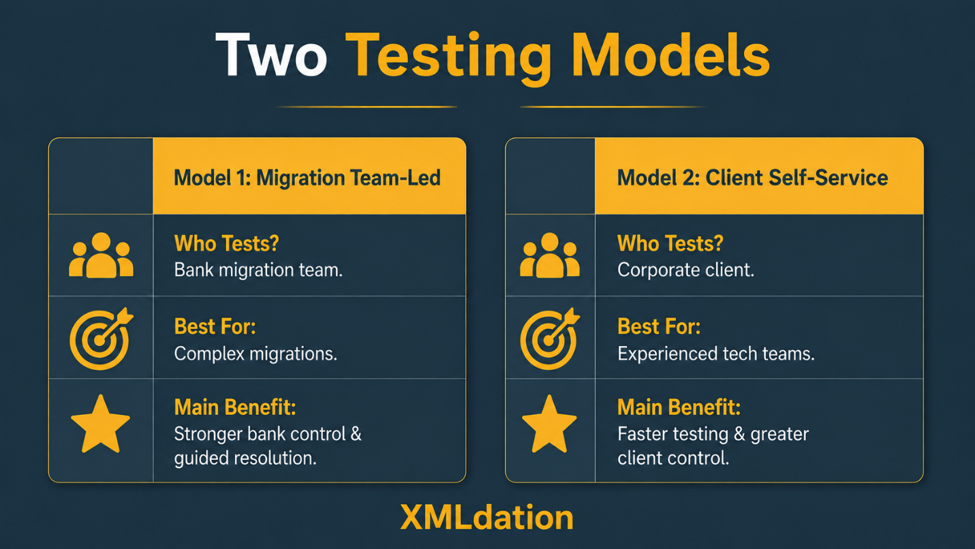
Model one: Migration team-led testing
In migration programmes, the bank must build a comprehensive view of all impacted corporate clients. For many large corporations, payments may originate from multiple ERP systems, treasury platforms, payroll applications, and banking connectivity channels, creating significant complexity.
Once the impacted clients are identified, ownership is assigned across migration team leaders. Each lead becomes accountable for a portfolio of corporate clients, serving as the primary point of contact throughout the migration journey. Internally, they work with product and testing teams to identify affected payment processes, define testing requirements, and establish a roadmap to production readiness.
Testing Process Steps
- Client creates and submits payment files
- Migration team (point of contact) uploads files to XMLdation’s PFT tool
- PFT validates the file (based on payment types)
- Migration team reviews results and provides feedback
- Client corrects issues and achieves production readiness
Model 2: Client Self-Service Testing
In this model, the bank enables corporate clients to manage much of their own payment file testing through a self-service testing platform.
The bank migration team first creates user access for each corporate client and explains what is changing, which payment types are impacted, and what needs to be tested before migration. The team then provides the client with access to the relevant payment file testing capabilities, based on the payment formats and scope.
XMLdation continues to enhance its platform for this use case: so that migration teams get better visibility, and more control over corporate readiness in a complex acquisition programme.
Testing Process Steps
- Client creates and uploads payment file to the pft tool.
- PFT validates the file
- Client reviews results: report highlighting any errors, warnings, or missing information.
- Client fixes and retests
- Bank migration team monitors progress
The real test begins after the deal closes.
With M&A activity regaining pace, headlines will continue to characterise transactions by their size or impact on the marketplace. Significant as these metrics are, members of the migration teams at acquiring banks can testify that the quality of execution measures success.
For these individuals, the true test starts once a deal is closed. It is their responsibility to ensure corporate clients are migrated to the new systems swiftly, smoothly and securely – keeping any disruption to day-to-day operations to a minimum. By providing migration teams and corporate clients with self-service testing, interactive documentation, and intelligent validation tools, acquirers can manage operational risk, expedite onboarding processes, and ensure a seamless transition for all M&A stakeholders.
In today’s business environment, where customers expect continuity and best-in-class service above all else, a bank’s ability to make complex migrations appear effortless is fast becoming a competitive differentiator.
2. https://www.reuters.com/markets/deals/bnp-paribas-regulatory-approvals-reached-complete-sale-bank-west-bmo-2023-01-18/
3. https://www.reuters.com/business/finance/hsbc-completes-sale-canadian-unit-rbc-2024-03-29/
4. https://www.reuters.com/markets/deals/nationwides-virgin-swoop-reignites-uk-banking-takeover-talk-2024-03-07