


Taking message implementation guides to the next level
Based on the needs of XMLdation’s bank customers across Europe and North America, we co-created a new interactive documentation feature that streamlines how message implementation guides and sample files are managed and shared. We explore the benefits for both the banks and their clients
In today’s globalised world, banks are increasingly conducting operations in multiple countries. Faced with growing operational complexity and the need to deliver best-in-class end-user experiences, many bank payments teams in Europe and North America have long relied on XMLdation’s Payment File Testing service, which enables corporate clients to self-register, upload payment files, and validate them against their bank’s internal message schema and business rules.
As expectations continue to evolve, however, even well-established tools must adapt. Building on the foundations of the Payment File Testing service, XMLdation – working closely with its bank clients – identified an opportunity to streamline how the tool manages message implementation guides and sample files. By maintaining these within the same master environment as the validation rules, the approach delivers clear efficiency gains and greater consistency across the service, supporting both direct users and their end customers.
So, how does this work in practice, and what benefits does it bring for both sides?
Streamlining rule sharing
The new feature enables bank payments teams to manage message implementation guide content in close cooperation with XMLdation – directly within the same service that houses the schema and business validation rules. This creates a simple and efficient mechanism for sharing updates to rules and rule descriptions.
Before the update, banks tended to maintain and generate their own publication-ready guides, relying on email to share message implementation guides and sample files with clients. This process ignored the clear synergies available between communicating guide information to clients, updating business rules in the File Testing Service, and maintaining the guides themselves. Recognising this disconnect, XMLdation set out to create a more integrated and streamlined approach.
Through the Payment File Testing Service, banks can now export service content to Excel, annotate required changes, and have XMLdation update and maintain the master information accordingly. This means that they no longer need to communicate guide updates separately to clients, making the overall process far more straightforward and easier to manage. In turn, this frees up back-office resources and improves the overall client experience.
Interactive documentation for clients
The updates also deliver major benefits to banks’ clients. With XMLdation’s interactive documentation feature, users can browse schema and business rules on-screen, filter to areas of interest, and view multiple payment types simultaneously – making it easy to compare how rules differ. For those who prefer traditional formats, guides can still be generated in PDF or Excel, now with the flexibility to render by a single payment type or across multiple types.
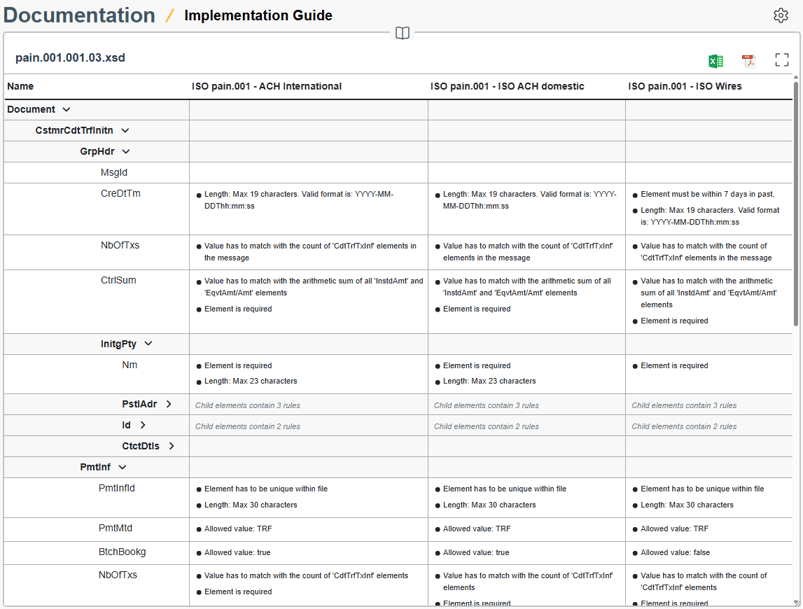
Picture 1: Interactive document
In addition to providing access to the guides, XMLdation added a simple mechanism that allows the bank to compare sample files against each other and against clients’ own files, enhancing transparency and improving the overall user experience.
Upscaling experiences – reducing overheads
Those using the tool are already finding that the administrative overhead for managing the payments product is now negligible. Not only can clients self-register to the service, but they can also directly access the documentation and sample files – removing the need for bank staff to relay the information via email. Furthermore, to ensure product owners stay abreast of usage trends, XMLdation enhanced the service usage reports and now make them available through automated emails.
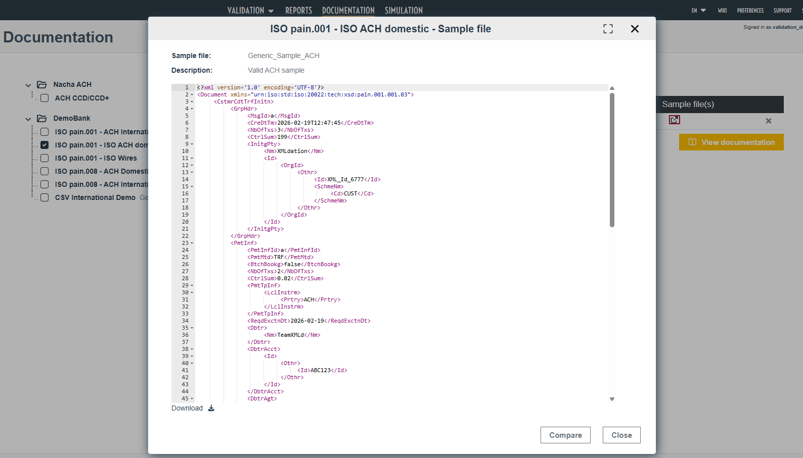
Picture 2: Sample file
The updates also deliver significant benefits for end users. With XMLdation’s interactive documentation feature, clients can browse schema and business rules on-screen, filter to areas of interest, and view multiple payment types simultaneously – making it easier to compare how rules differ. Guides can still be generated in PDF or Excel, with added flexibility to render by a single payment type or across multiple types.
The result is a more aligned and efficient operating model: message implementation guides remain continuously up to date, documentation and validation are managed within the same environment, and banks spend less time on manual administration. It also underscores the value of close collaboration between XMLdation and its banking clients – where operational challenges are surfaced early, solutions are co-developed, and improvements ultimately benefit both internal teams and end customers.
Tricia Balfe, CEO, XMLdation, commented: "There are areas of payments operations that demand time and effort without delivering much added value. Our bank customers recognise this, and by collaborating closely we were able to understand their pain points, focus on what mattered most, and design a far more efficient way of managing this work.”
See also: Documentation demo