


RTR in Canada: A new payments model and a new testing imperative
Canada’s payments sector will undergo change in 2026 with the introduction of its long-awaited Real-Time Rail (RTR) – a new national infrastructure designed to move money instantly, 24/7/365, built on the richer, data-driven ISO 20022 messaging standard.
This shift – toward real-time, data-rich and always-on payments – will open the door to greater competition and a broader range of payment propositions. At the same time, however, it significantly increases operational and technical complexity, bringing coordinated, automated testing firmly into the spotlight.
A new model for participation and settlement
Designed as a national infrastructure for instant payments, RTR will enable irrevocable transactions to be cleared and settled within seconds – but speed is just one part of a broader transformation. Historically, payments in Canada have been underpinned by a bank-centric model, with other participants relying on banks to access the infrastructure.
Recent regulatory reforms – including the revised Canadian Payments Act and the November 2024 launch of the Retail Payments Activities Act (RPAA) – extend this access beyond traditional financial institutions, opening the system to regulated PSPs and non-bank participants. This is set to shift the market away from the reliance on incumbent banks and toward more open and competitive payments (see Figure 1).
Figure 1: Evolution of Canada’s payments model
|
Pre-2026: Bank-Centric Model |
Post-2026(RTR): Direct Access Competition Model |
|
|
Opening the ecosystem: The first wave of PSP participation
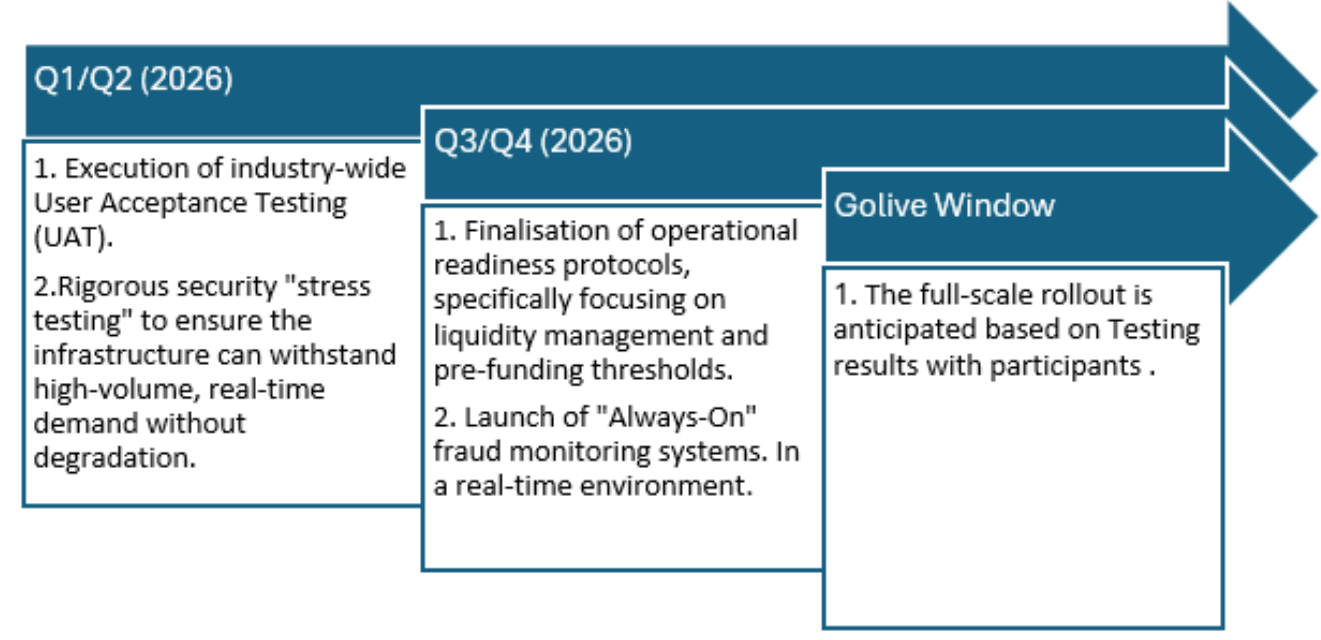
As RTR moves through industry testing in 2026 (see Figure 2), the first wave of non-bank PSPs – including Wise, Float, KOHO, Paramount Commerce, DoBusiness.com and Brim Financial – are preparing for direct participation. Beyond non‑bank PSPs, credit unions have shown interest in joining RTR and Meridian is the first provincial credit union to participate in the RTR program. Historically, these firms relied on bank partners – often direct competitors – for clearing and settlement, creating operational dependencies, increasing costs, and limiting innovation. Direct access, by contrast, will provide greater autonomy over settlement, liquidity, and customer experience to create a more level playing field.
As these new participants are onboarded ahead of go-live, attention is already turning to the technical resilience of the RTR infrastructure, as a growing and more diverse participant base places greater emphasis on testing and sustained operational readiness.
At the same time, the introduction of ISO 20022 brings with it more complex schemas that can create integration risks if not properly managed. As a result, testing priorities in an ISO 20022 environment become critical – including regression testing for legacy bridge systems, as well as validation of settlement, prefunding and end-to-end data movement.
Figure 2: Go-live roadmap for RTR
Putting testing at the top of the agenda
In a real-time environment, even small inconsistencies – such as variations in schema implementation or message interpretation – can result in rejected payments, reconciliation breaks, or downstream processing issues. Combined with the inherent complexity of ISO 20022, this makes robust, standardised testing essential.
For rail operators, this creates a need to support testing at scale. As participant numbers grow and onboarding occurs in multiple waves, testing frameworks must be streamlined, repeatable, and capable of supporting a wide range of scenarios across different participants.
At the same time, as real-time payments become embedded into core products and workflows, the onus is on banks and PSPs to take greater ownership of their own testing strategies. This means building comprehensive, end-to-end test cases aligned to their systems, use cases, and change cycles, rather than relying solely on rail-mandated testing.
New developments – the rise of the productised “Test Bank”
A concept gaining traction globally is XMLdation’s productised test participant – often referred to as a “Test Bank” or “Virtual Buddy Bank”. In some markets, infrastructures provide this capability during industry testing, enabling participants to perform end-to-end tests without coordinating with counterparties – BancNet Instapay in the Philippines is one example. In other cases, vendors connect directly as test participants on the rail and deliver end-to-end testing capabilities to banks, as seen with EBA Clearing’s RT1 in Europe.
In the case of Canada’s RTR implementation, this model could support the rail operator in scaling testing more effectively, while giving banks greater control over their testing strategies and reducing dependency on external participants.