


U.S. real-time payments testing made easy, with a bank buddy
ACH has been the [TB1] [As2] go-to payments rail for U.S. financial institutions for decades – a steady, reliable network that has seen little change over the years. Now, as real-time payments become standard and the drive for payments modernization grows, FIs are increasingly connecting to new rails like TCH RTP and FedNow, and, in turn, must get to grips with far more frequent payments testing. Tricia Balfe, CEO, XMLdation, examines the multiple challenges of manual end-to-end testing, and reveals how adopting a Buddy Bank™ self-service simulator brings configurable, on-demand solutions to your fingertips.
“The U.S. may have been slightly late to the real-time payments party, but it is fast becoming a leader on the real-time payments stage.”
The real-time payments revolution is in full swing across the U.S., with volumes and values soaring in 2025. The Clearing House’s (TCH) RTP network saw total payments rocket from $246 billion in 2024, to $1300 billion in 2025[1]. Meanwhile, FedNow’s Faster Payments reported Q4 year-on-year growth of over tenfold: from $20 billion in Q4 2024, to $251 billion in Q4 2025[2].
This isn’t a flash in the pan. The number of real-time transactions in 2025 was 455.6 million[3][4]. This figure is set to reach eight billion in 2026, rising to nearly 13.9 billion by 2028 – a compound annual growth rate of more than 30%[5]. The U.S. may have been slightly late to the real-time payments party, but it is fast becoming a leader on the real-time payments stage.
Recent growth can be attributed to a number of factors. The rails themselves are introducing enhancements, such as increases to transaction limits (now $10billion for both rails). This is expanding use cases to incorporate more high-value B2B payments. TCH has also created a funding model that enables smaller FIs, including community banks, to join RTP at a reduced rate, thereby helping to democratize access to real-time payments.
“With innovation and regulation driving change, it is not uncommon for banks’ internal systems to undergo quarterly updates, while most rails have annual updates.”
Additionally, the wider drive to phase out paper checks is contributing to greater adoption of electronic payments, including real-time. It was mandated by the U.S. Department of the Treasury that federal agencies migrate to electronic disbursements by September 2025, for example. More broadly, there is a push for ubiquitous payment modernization nationwide.
Further fueling client demand is the focus on working capital optimization – something compounded by the huge volumes of trapped liquidity currently in the financial ecosystem[6]. The importance of real-time settlement as a means of enhancing working capital has therefore become more pronounced. Certainly, companies that rely on just-in-time cash flow, such as Midwest manufacturers, place particular value on real-time payments. As does the rapidly expanding gig economy. With 80% of gig workers prioritizing platforms that pay instantly, and with the volume of gig workers due to exceed 86 million by 2027[7], the incentive for corporates to be able to offer real-time capabilities is growing.
Real-time enablement
In parallel, application programming interfaces (APIs) and ISO 20022 messaging frameworks are making it easier for organizations to integrate real-time capabilities into existing systems. API-based payments services – which enable more automated payment initiation – are becoming increasingly prevalent within banks’ offerings. This, in turn, is driving corporate client demand for immediate payment execution, shifting expectations from “submit a payment instruction” to “make money move now”.
“As FIs increasingly connect to new rails like TCH RTP and FedNow, they must in turn get to grips with far more frequent payments testing.
Overall, a host of payment types are increasingly moving to real-time rails, including payroll, insurance payouts, gig economy disbursements, supplier payments and government transfers[8]. And as momentum for real-time builds further, with the landscape moving towards adoption and scale, banks need the real-time rail capabilities to facilitate the evolving landscape.
Participation on the RTP and FedNow rails is becoming well established across banks and credit unions. In 2026, FedNow saw payment volumes increase by 80% in Q2, compared with the previous quarter. The growth was driven by 111 additional FIs joining the service, alongside increased usage from existing participants[9]. As of July 2026, FedNow has over 1800 members and RTP over 1200[10]. With approximately 9000 FIs in the U.S., this figure represents one third, representing a critical mass of FIs across the two rails.
The buzz around real-time payments, their benefits and potential to enhance business operations is clear. But as FIs increasingly join the real-time payments revolution, with an increasing number of banks becoming senders as well as receivers on RTP, the need to keep on top of industry changes to different rails and manage risk when updating their own systems becomes more involved and complex.
Near-perpetual payments testing is becoming the new normal
Thorough, rigorous and ongoing testing is an imperative part of the real-time payments reality. This is to mitigate risk and ensure any change does not impact ongoing rail usage and performance. When joining a new rail, there are set, compulsory use cases that banks need to be able to perform prior to going live. But there is also a host of bespoke use cases that an individual bank must test in order to understand how their own system behaves under different scenarios. This bespoke, end-to-end testing needs to take place when joining a new rail, and also with every rail upgrade, every new regulation and every update to a bank’s internal system.rrompared with the pre-ISO 20022 era, when little testing was needed because changes to ACH and FedWire were rare, testing is becoming considerably more challenging and frequent. Today, with innovation and regulation driving change, it is not uncommon for banks’ internal systems to undergo quarterly updates, while most rails have annual updates..
“While testing with partner banks is an extremely valuable means of performing test case “dry runs”, it is fully dependent on the availability and readiness of another party.”
As the emphasis on testing shifts from sporadic to near-perpetual, FIs increasingly need to rethink not only when, but how they test. This applies whether a bank is a direct participant of a rail or is connected indirectly through a partner bank or vendor. Indirect participants, which are typically smaller banks, still need to perform testing to check their systems are working proficiently.
Traditional testing methods aren’t up to speed
Currently, a three-pronged approach tends to be used by banks to carry out effective payments testing:
- building a specific internal testing suite,
- using readiness tools provided by the market infrastructure or scheme,
- coordinated testing with partner banks during agreed test windows.
Each approach has limitations, however (see Figure 1). For example, while testing with partner banks is an extremely valuable means of performing test case “dry runs”, it is fully dependent on the availability and readiness of another party, with coordination complications adding to potential delays, inefficiencies and frustration. Further restrictions include the fact that only use cases that the partner bank is able and prepared to perform can be tested. In addition, the partner bank approach is not applicable for every scenario that requires testing, such as when verifying the impact of a bank's own internal system upgrades. It is usually only an option when onboarding to a rail or when a new regulatory standard is being introduced.
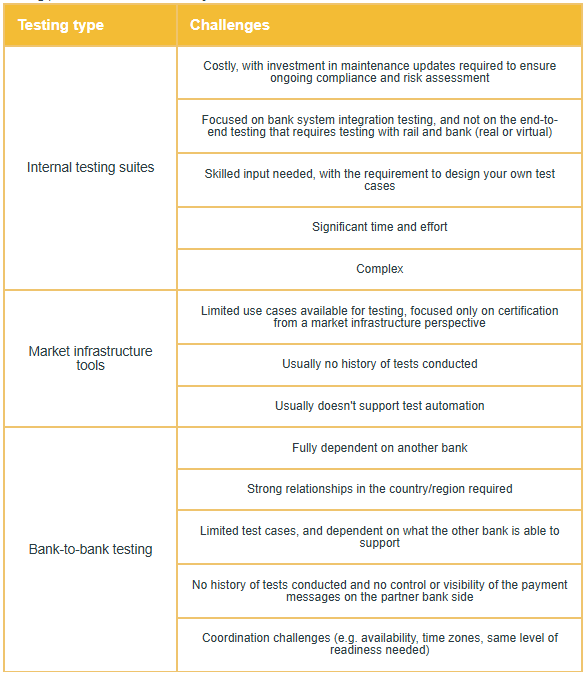
Figure 1. Limitations of existing payments testing methods
As payments testing becomes an ever-larger part of FIs’ ongoing operations, the need for a practical and optimized approach is clear.
Test any type of payment scenario, any time with a virtual banking partner
Enter Buddy Bank™. Acting as a simulated banking partner, the self-service tool enables independent, automated, end-to-end testing for RTP payments. Such cutting-edge capabilities are possible because Buddy Bank™ has TCH approval to connect directly to the RTP rail, with its own dedicated RTN and Participant ID, making it easily accessible by FIs’ core systems, and getting started seamless. For indirect participants, they can access the tool via their direct participant partner.
“Buddy Bank™ has TCH approval to connect directly to the RTP rail, with its own dedicated RTN and Participant ID, making it easily accessible by FIs’ core systems, and getting started seamless."
Buddy Bank™ is fully configured to perform the suite of compulsory RTP test cases, enabling users to send and receive test payments, and run all the scenarios needed for certification. Nt only that, scenarios are fully customizable to ensure comprehensive testing of every use case a bank wants to test – covering delays, duplicates, late payments and more. This gives FIs the opportunity to uncover and resolve potentially sensitive issues before undertaking any penny tests with another bank. Automated regression testing is another key feature, delivering assurance of ongoing system robustness, reliance and compliance.
“Buddy Bank™ is fully configured to perform the suite of compulsory RTP test cases, enabling users to send and receive test payments, and run all the scenarios needed for certification.”
What this means:
|
This ability to perform continuous, rigorous end-to-end testing automatically, and with far greater control, is an optimized means of reducing risk. It is a significant improvement on traditional testing processes – where FIs rely on coordinated testing with friendly banks – delivering enhanced efficiency and cost effectiveness. With the solution also reducing strain for overstretched internal teams and freeing-up resources for more value-added tasks, combined with greater cost efficiency due the removal of the need for ongoing investment into testing in accordance with ongoing standard and configuration shifts, this form of testing is a no-brainer for many banks..
“As the emphasis on testing shifts from sporadic to near-perpetual, FIs need to rethink not only when, but how they test.”
Preparing for the U.S. vision of real-time cross-border payments
Beyond domestic real-time payments, RTP and FedNow are increasing their focus on international payments. There is growing interest in one leg out solutions, where participants could use intermediaries for the international leg of a cross-border payment, while settling the domestic leg through RTP or FedNow.
These developments do not make either rail a cross-border payments system, but they do enable U.S. domestic infrastructure to facilitate one end of an international payment. Effectively, this would generate interoperability with other real-time domestic rails, such as Payments Canada’s soon-to-launch RTR, and SEPA’s OCT Inst rail in Europe, which is used for one leg out transactions.
As real-time cross-border initiatives become more established, U.S. FIs that operate – or are looking to operate – in multiple markets will increasingly need to connect with multiple real-time domestic rails across the globe. Certainly, it is not uncommon for larger banks to be participants in excess of 20 rails. The more rails you have, the more testing will need to be done – not simply upon initial adoption, but ongoing, in order to incorporate regular upgrades. Indeed, new iterations of real-time rails are typically introduced once per year. This, combined with banks’ internal system updates – which can occur once a quarter or more due to rapid technology enhancements and innovations – equates to an unmanageable amount of annual testing when using existing methods, particularly given that internal teams’ capacity is often extremely overstretched. An FI can expect five annual testing cycles per rail (see Figure 2) and as additional rails are adopted, end-to-end testing spirals. Moreover, the same testing need will apply when supporting one leg out (see Figure 3). End-to-end testing on an international level will therefore become essential in ensuring end-to-end maintenance, robustness and interoperability across a bank’s suite of rails.
|
More rails = more testing: The increasing payments testing challenge for FIs |
||
| #Rails
|
Example rails |
Annual testing cycles (for rail + bank system updates) |
|
1 rail |
TCH RTP |
5 |
|
2 rails |
TCH RTP, FedNow |
10 |
|
5 rails |
TCH RTP, FedNow, ACH, FedWire, CHIPS |
25 |
Figure 2: Testing volumes for US domestic rails
|
More currencies = more testing |
||
|
|
Example |
Annual testing cycles |
|
1 currency |
CAD |
5 |
|
6 currencies |
CAD, MXN, EUR, INR, GBP, SGD |
30 |
Figure 3: Testing volumes for one leg out
For this to be possible and sustainable, automated testing must evolve in tandem. Without automation, a bank would need to find partner banks and testing windows for rails in every country in which they want to operate. This is in addition to navigating the varying regulations and standards of each market.
But integrating an automated Buddy Bank™ simulator as another layer removes the complexity, enabling testing of all the local instant payments schemes, and the testing and validation of the overall infrastructure. This provides banks with the assurance that necessary, up-to-date testing is being taken care of, incorporating all new requirements and individual rail developments, to ensure ongoing compliance and risk mitigation. This approach would allow U.S. banks to use a common solution for the end-to-end testing of all their rails, acting as a real enabler of real-time cross-border payments adoption, and a vital tool for banks with ambitions for growth. XMLdation plans to expand its simulator capabilities to other instant payment rails across the globe as client needs dictate.
XMLdation’s Buddy Bank™ is bringing real-time payments testing capabilities up to speed with real-time payments themselves. With client demand and industry developments making real-time a growing imperative, it is important that payments testing isn’t the barrier to delivery. Make the grade with payments testing: buddy up with RTP Buddy Bank™.
“Buddy Bank™ is bringing real-time payments testing capabilities up to speed with real-time payments themselves."
[1] What RTP and FedNow rule changes mean for cross-border payments | American Banker
[2] FedNow proposes support for cross-border payments | American Banker
[3] RTP — United States | Real-Time Payment Data | RTP Dashboard
[4] FedNow — United States | Real-Time Payment Data | RTP Dashboard
[5] PYMNTS | US Real-Time Payments Hit Growth Phase as Use Cases Multiply
[6] U.S Real Time Payments Market Size, Outlook & Growth Report, 2031
[7] U.S Real Time Payments Market Size, Outlook & Growth Report, 2031
[8] PYMNTS | Real-Time Payments World Map - March 2026
[9] Real-time payments in Europe vs FedNow in the US | The Paypers
[10] How instant payments are reshaping commercial banking | McKinsey